Reshoring the Factory, Importing the Skill Gap: America's Industrial Workforce Paradox
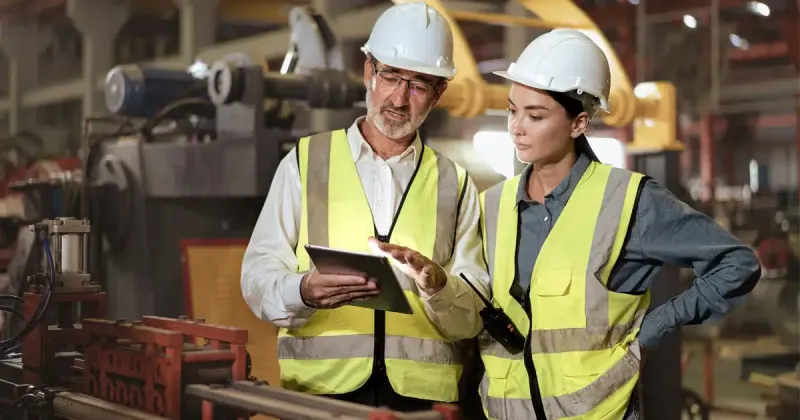
Photo: manufacturing worker training modern industrial equipment factory, via www.augmentir.com
The United States is in the midst of a significant manufacturing resurgence, with reshoring announcements reaching record levels and federal incentives accelerating facility construction across multiple sectors. But a critical obstacle is emerging beneath the headlines: the workers available to staff these facilities frequently lack the technical fluency required to operate the intelligent, connected systems that define modern industrial production. The gap between workforce availability and workforce readiness is quietly becoming the reshoring initiative's most consequential constraint.
A Return Built on Different Foundations
For decades, American manufacturing employment declined as production migrated offshore in pursuit of lower labor costs. The facilities that remained stateside often operated with aging equipment and legacy processes — environments where deep mechanical intuition and years of hands-on experience were the primary qualifications for a skilled operator.
The factories returning to American soil today are fundamentally different. Competitive economics now demand that reshored facilities operate with levels of automation, connectivity, and data-driven optimization that were largely absent from the operations that left a generation ago. A semiconductor packaging plant in Arizona, a battery cell facility in Ohio, or a precision components manufacturer in South Carolina is not recreating the factory floor of 1995. It is deploying IIoT-connected equipment, edge computing nodes, digital twin environments, and AI-assisted quality control systems.
The workforce pipeline, however, has not kept pace with this transformation.
What Modern Industrial Systems Actually Require
Understanding the depth of the skills mismatch requires clarity about what operating a modern connected manufacturing facility actually demands from its workforce.
At the operator level, personnel must be comfortable interacting with human-machine interfaces that present real-time process data, respond to algorithmic alerts, and navigate configuration menus that govern automated sequences. These are not tasks that require engineering degrees, but they do require a baseline of digital literacy and comfort with software-driven environments that many traditional manufacturing candidates do not possess.
At the technician level, the requirements intensify considerably. Maintenance personnel must understand not only the mechanical systems they service but also the sensor networks, communication protocols, and edge computing platforms that monitor those systems. Diagnosing a failure on a modern industrial machine may require interpreting network traffic logs as readily as reading a hydraulic schematic.
At the systems integration level — a role that did not exist in most facilities twenty years ago — personnel must understand how OT and IT environments interact, how data flows from device to cloud, and how software updates to one system layer affect performance across others.
The domestic labor market does not currently produce these competencies in sufficient volume to meet the demand that reshoring is generating.
The Community College Gap
American community colleges and technical schools have historically served as the primary pipeline for skilled manufacturing talent. Programs in machining, welding, electrical systems, and industrial maintenance have produced generations of capable floor workers.
Many of these programs, however, are still built around the equipment and skill sets of the previous industrial era. A student completing a two-year industrial maintenance program may graduate proficient in pneumatic systems and relay logic — genuinely valuable competencies — without ever having configured a networked sensor, interpreted an OPC-UA data stream, or navigated a modern SCADA interface.
This is not an indictment of those programs or the institutions that run them. Curriculum development in technical education moves slowly, and the industrial technology landscape has shifted faster than most educational institutions can track. But the result is a pipeline misalignment that employers are encountering in real time.
Manufacturers posting positions for IIoT systems technicians, connected equipment operators, and industrial network administrators routinely report candidate pools that are either too narrow or too underqualified. Those who do possess the relevant skills frequently command compensation expectations that smaller and mid-sized manufacturers struggle to meet.
The Arbitrage That Isn't Working
The term "skills arbitrage" has emerged in workforce planning discussions to describe the strategy of hiring workers with adjacent competencies and bridging the gap through internal training. In theory, a mechanically proficient technician with strong problem-solving instincts can be trained on modern industrial platforms. In practice, the arbitrage is proving more expensive and time-consuming than most facilities anticipated.
Internal training programs require dedicated instructors, structured curricula, and — critically — time during which new hires are not yet fully productive. For facilities operating on tight timelines and thinner margins, the carrying cost of extended onboarding can be significant. When a facility needs fifty trained IIoT operators and must train each one from a baseline of general mechanical knowledge, the production ramp takes months longer than projections assumed.
Some manufacturers have responded by contracting with technology vendors for embedded training support — a model in which the company supplying the industrial computing platform also provides operator and technician education as part of the deployment package. This approach can accelerate competency development, but it introduces its own dependencies and does not address the long-term structural gap in the workforce pipeline.
What Forward-Looking Manufacturers Are Doing
A subset of manufacturers navigating this challenge has begun investing upstream — engaging with technical schools, community colleges, and workforce development boards before their facilities open, rather than after. By providing equipment donations, curriculum input, and internship pipelines, these companies are attempting to shape the educational environment in ways that produce more job-ready candidates.
Others have restructured their job architecture, disaggregating roles that previously required combined competencies into more specialized positions that can be filled from narrower talent pools. Rather than searching for a technician who understands both mechanical systems and industrial networking, they hire for each domain separately and build cross-training into the long-term development path.
A third approach involves investing in interface design — selecting industrial computing platforms that present complex system data in more intuitive, role-appropriate formats, reducing the learning burden on operators who may not have deep technical backgrounds. The right HMI design does not eliminate the need for skilled workers, but it can meaningfully reduce the threshold of technical knowledge required to operate a connected facility effectively.
The Structural Question
Ultimately, the skills arbitrage problem is not one that individual manufacturers can solve in isolation. The mismatch between the workforce America has and the workforce its reshored factories need reflects a structural gap that accumulated over decades of manufacturing decline and underinvestment in industrial technical education.
Closing that gap will require sustained coordination between industry, educational institutions, and workforce development policy — a long-cycle effort measured in years, not quarters. In the interim, manufacturers bringing facilities back to American soil must plan for the skills deficit as a known operational variable, not an unexpected obstacle. The factories are returning. The workforce readiness infrastructure must be built alongside them.